Handling New In-Laws After Remarriage in India: What to Expect

The first family lunch after remarriage can feel like an interview where nobody admits there is an interview.
Someone watches how you speak to your spouse. Someone compares you silently with the past. Someone is kind, but careful. You may be trying to respect everyone while also wondering where you fit.
New in-laws after remarriage in India need patience because the family is not starting from a blank page. They may be protective, unsure, grieving, or simply adjusting to a new person entering an old family system.
Why New In-Laws Feel Different In A Second Marriage
In a first marriage, families often expect a fresh beginning. In a second marriage, there is history.
Your spouse's parents may have seen the earlier marriage end. They may have supported their child through divorce, separation, widowhood, or parenting stress. They may be cautious because they do not want another painful chapter.
If your spouse has children, the in-law relationship becomes more layered. Grandparents may worry about the child, the previous family structure, and how much change is coming.
If widowhood is involved, your spouse's family may still hold deep affection for the late spouse. That does not mean there is no place for you. It means grief and acceptance may need to share the room for a while.
Let Your Spouse Lead Their Family
The most helpful rule is simple: each partner should lead communication with their own family.
If your mother-in-law is anxious, your spouse should speak first. If a sibling is comparing you with the previous partner, your spouse should set the boundary. If a festival plan is unclear, your spouse should explain what is possible.
This protects you from becoming the outsider who is "changing everything." It also shows the family that your spouse is choosing this marriage clearly.
Mini checklist: Ask your spouse what should be shared, what should wait, and what boundary they will personally communicate before the next family event.

Caption: This map keeps the in-law adjustment focused on steady trust, protected history, and spouse-led boundaries.
Do Not Try To Win Everyone Quickly
Trying too hard can create pressure on both sides.
You do not need to become the perfect daughter-in-law, son-in-law, stepparent, festival host, and emotional healer in the first few months. Consistency is more convincing than performance.
Small actions help:
- Call or message on important days.
- Attend family events when realistic.
- Learn one or two family preferences without pretending to be someone else.
- Be polite even when you are still finding your place.
- Let warmth grow through repeated ordinary moments.
Trust after remarriage is usually built slowly. That is normal.
Keep Children And Private History Protected
New in-laws may ask questions about children, divorce, custody, finances, or your past. Some questions may be practical. Some may be too personal.
You can answer broad facts without opening every private detail.
Useful boundaries include:
- "The children are adjusting slowly, so we are keeping details private."
- "That part of the past is not something I want to discuss in a group."
- "My spouse and I have spoken about this, and we will share what is needed."
- "Please do not share child photos or details without asking us."
If children are involved, read second marriage with kids and co-parenting after remarriage before family expectations become too fixed.
Handle Comparison Without Competing
Comparison can happen after divorce and after widowhood, even when nobody says it directly.
Do not compete with a previous spouse. Do not ask your partner to erase their past. Do not measure your place by how quickly every relative becomes warm.
You can say:
"I understand this is a change for everyone. I am not here to replace anyone's history. I am here to build a respectful relationship from now."
That kind of sentence is calm, honest, and difficult to argue with.
Know When A Boundary Is Needed
Some in-law tension is normal adjustment. Some behaviour needs a boundary.
Set limits if there is:
- Repeated insult or humiliation.
- Pressure to share private documents or child details.
- Attempts to control your spouse's decision.
- Disrespect toward children from a previous marriage.
- Constant comparison with a previous partner.
- Interference in co-parenting arrangements.
The boundary should usually come from your spouse first. If the pattern continues, the couple may need counselling, mediation, or legal advice depending on the situation.
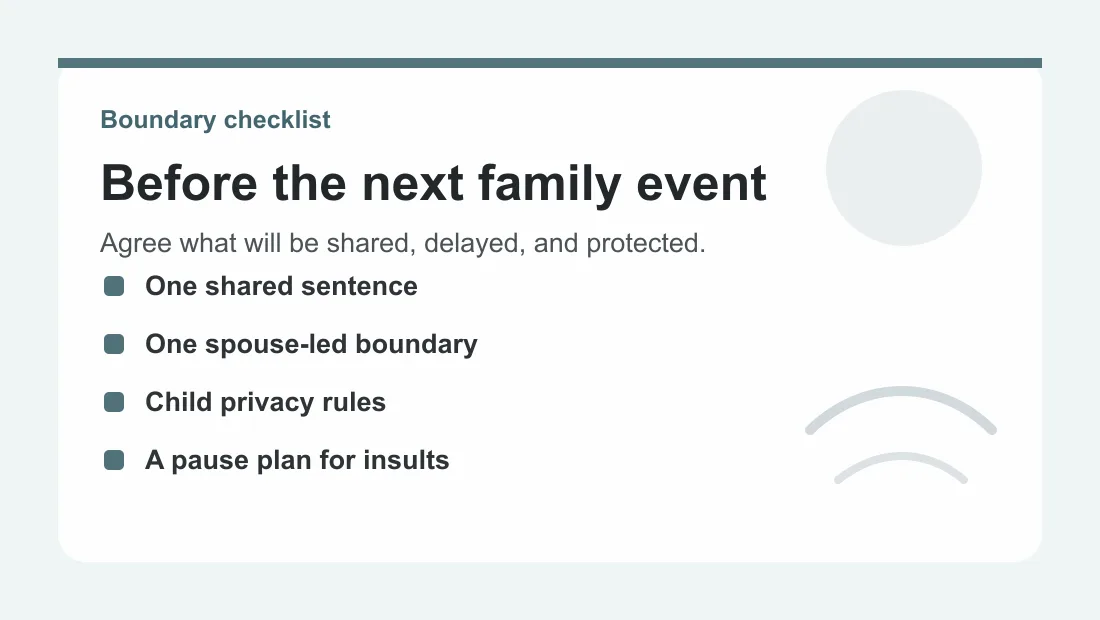
Caption: This checklist helps couples agree what to share, what to delay, and what to protect before family events.
A Practical Next Step
Before the next in-law meeting, agree on one shared sentence with your spouse. For example:
"We want everyone to adjust slowly, but we also need our marriage and the children's privacy to be respected."
If you are still planning your remarriage search, second marriage matrimony gives a broader view of the decisions that come before family involvement.
A second marriage does not need instant family closeness to be healthy. It needs a couple that stays respectful, united, and patient while new relationships find their natural place.
FAQs
How long does it take to feel comfortable with new in-laws?
There is no fixed timeline. Some families warm up quickly, while others need months of steady, respectful contact before trust feels natural.
Should I directly confront difficult in-laws?
Start by discussing the issue with your spouse. In most cases, your spouse should speak to their own family first, especially when the issue affects the marriage or children.
What if my in-laws compare me with the first spouse?
Do not compete with the past. Ask your spouse to set a respectful boundary, and keep your own behaviour steady. Your role is to build a new relationship, not erase an old one.
Should new in-laws meet children immediately?
Not always. Children should be introduced gradually and only with clear adult planning. Protect their privacy, routine, and emotional pace.
Can counselling help with in-law conflict?
Yes, when conflict is repeated or affecting the couple. A family counsellor or marital counsellor can help the couple set boundaries and communicate more clearly.
Sources
Next step
Compare platforms, check safety, or request a reviewed path when you are ready.
Editorial Team
Practical, respectful guidance for divorced, separated, and widowed adults building a thoughtful second chapter.
More blogs to read

Second Marriage in India: Legal, Family, and Practical Guide
Someone can feel ready for second marriage in India emotionally and still have practical questions waiting at the door. Is the earlier marriage legally over? What should be disc...

Single Parent Matrimony in India: What to Discuss Before Remarriage
Single parent matrimony in India needs more care than a normal profile search. A parent is not only asking, "Can I find a partner?" They are also asking, "Will this decision be...